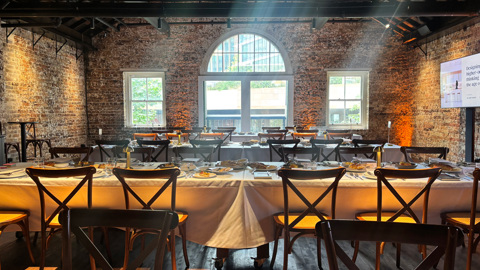
We recently welcomed Dr Libby Sander in Sydney for a lunch and learn event, The AI-ready workplace: Rethinking space for what comes next.
The presentation and workshop explored the human demands of AI and what they mean for workplace design. Libby, an Associate Professor of Organisational Behaviour at Bond University, drew on her research to help us consider how our environments support focus, judgement, creativity and connection.

For anyone making decisions about their workplace, the discussion offered a useful starting point: Consider how the work itself is changing, and what people need to do it well.
Plan for the thinking behind the task
As routine tasks become faster or more automated, the work around them can change.
A team using AI to help prepare a proposal, for example, may still need time to review the material, question assumptions and develop a recommendation. They may then need to come together to discuss the options and make a decision.
That sequence calls for both concentration and collaboration. Workplace planning needs to consider when and where each happens, and whether people can move easily between them.
Understanding these patterns gives a design brief something concrete to respond to: the tasks people perform and the conditions those tasks require.
Revisit the mix of spaces
Changes in the work do not automatically tell us whether an organisation needs more or less office space. They do give us a reason to review how that space is used.
A meeting room booked throughout the day might appear to demonstrate strong demand for group discussions. If it is mostly occupied by individuals taking video calls or seeking quiet, it tells a different story.
Similarly, providing several types of setting does not guarantee that people can find a suitable place when they need it. Location, comfort, availability and expectations around use all matter.
Looking closely at these everyday experiences can help organisations make better-informed decisions about their footprint and the balance of settings within it.
Consider working habits alongside the layout
The physical environment is one part of the picture. How teams organise their day also shapes whether a workplace supports good work.
A quiet space is more useful when people have uninterrupted time to use it. A collaborative setting works best when there is a clear purpose for coming together.
If AI saves time on a task, it gives us an opportunity to reconsider how that time is used. Teams may need more time to assess information, discuss a recommendation or pause between demanding tasks.
Reviewing meetings, interruptions and team routines alongside the physical space can help identify what needs to change. Some adjustments may be worth testing in the current workplace before committing to a larger investment.
Take the ideas back to your team
Our short guide offers four practical ideas and questions to help your team explore how AI could change the work you do, the spaces you need and the habits that shape your day. Use it to identify one small change to test in your own workplace.